
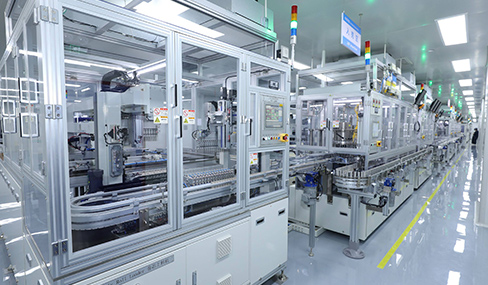
Lithium battery
A vacuum solution suitable for the manufacturing process of lithium-ion batteries.
Lithium ion battery manufacturing process
Vacuum is crucial in multiple stages of the lithium-ion battery manufacturing process.
Including: from mixing, drying, filling, degassing to sealing. Without vacuum, many steps would not even be possible.
Mixed slurry
The preliminary mixing process of the slurry with lithium metal oxide, binder, and solvent is carried out under vacuum.
This can prevent bubbles from entering the process and ensure a pure and uniform slurry is obtained.
As a result, the battery capacity has been increased.
Extreme drying
In the drying process, vacuum is also used to gently remove moisture and other solvents.
Vacuum drying can be carried out in batches (single chamber) or synchronously (multi chamber system, usually seven to nine chambers).
Inject electrolyte
With the help of vacuum, the battery is evacuated to ensure that there is no residual moisture or air. Afterwards, electrolyte filling is also carried out in a vacuum environment to ensure uniform distribution of electrolyte within the battery.
Immersion of lithium-ion battery cells
The contact between electrodes and electrolyte is crucial for the functionality and efficiency of battery cells.
Vacuum helps to complete this process, ensuring that there are almost no gaps between the two when they come into contact.
Electrolyte degassing
The electrolyte is degassed under vacuum to eliminate bubbles. In this way, lithium ions can move freely, enabling the battery to charge and discharge efficiently.
This website uses cookies to ensure you get the best experience on our website.


 +86-13925700120
 service@yitaervacuum.com
 Whatsapp+86-13602350906

 العربية
  Deutsch
  Español
  Français
  Italiano
  한국어
한국어  Português
  Русский
  Türkçe
  Tiếng Việt